


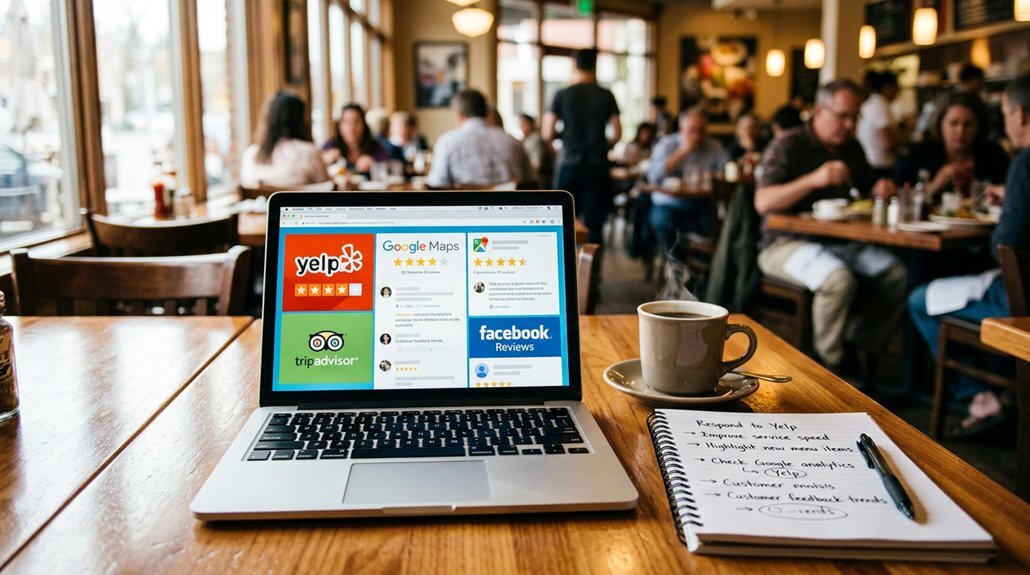
Managing third-party review platforms like Yelp, Google, and TripAdvisor isn't optional—it's survival. With 94% of diners checking reviews before choosing a restaurant, your online presence directly impacts your revenue. A single star increase on Yelp can boost earnings by up to 9%, while ignoring negative feedback drives 29% of potential customers away. You'll need consistent listings, smart response strategies, and reliable monitoring systems to stay competitive. Everything you need to make that happen is covered ahead.
Why Online Reviews Make or Break Your Restaurant
 .
.
Whether you realize it or not, your restaurant's reputation now lives primarily online, and the numbers behind that reality are striking.
Between 94 and 98% of diners consult reviews before choosing where to eat, meaning nearly every potential customer judges you digitally before ever walking through your door. A single star increase on Yelp can generate a 5-9% revenue boost for independent restaurants, and tables fill 19% more frequently during peak hours as ratings climb. Additionally, maintaining NAP consistency across platforms can further enhance your online visibility.
Meanwhile, 29% of customers actively avoid restaurants based on negative reviews. Your competitors understand this dynamic, and the ones winning aren't necessarily serving better food—they're managing their online presence more strategically.
Nearly 1 in 3 customers won't visit your restaurant because of negative reviews—your competitors already know this.
Reviews aren't supplemental marketing anymore; they're your primary storefront, and ignoring them costs you real money. Higher-rated restaurants also benefit from better search rankings, making them more visible to potential customers who are actively looking for a place to eat.Which Review Platform Drives the Most Restaurant Traffic
When it comes to driving restaurant traffic, not all review platforms are created equal—and understanding which ones actually move the needle can reshape how you invest your time and energy.
Google dominates, with over 90% of restaurant discovery happening through search engines and map applications. That's not a small margin—that's where your customers are actively looking. Additionally, community engagement through local events can significantly enhance visibility and attract new customers.
Meanwhile, platforms like Yelp, OpenTable, and TripAdvisor collectively attract 25% more consumers than professional food critics ever could.
Here's what matters most: 94% of diners consult reviews before choosing a restaurant, meaning your presence across multiple platforms isn't optional—it's essential.
Restaurants using Google's online ordering integration receive 2.5 times more orders than those without it.
Visibility isn't passive; it's built deliberately, platform by platform. Savvy operators are discovering that minimizing complaints across these platforms drives more traffic than accumulating five-star reviews, with units achieving the lowest complaint ratios seeing a measurable lift in traffic performance.How to Set Up Your Restaurant Listings the Right Way
.
Setting up your restaurant listings correctly isn't glamorous work, but it's the foundation everything else rests on. Start with your NAP—Name, Address, Phone—and make sure it's identical across every platform: Google, Yelp, TripAdvisor, Facebook, Apple Maps, and every delivery app you're on.
One inconsistency can confuse Google's algorithm and cost you rankings. Building local partnerships can also enhance your visibility and credibility.
Complete every section of your Google Business Profile: categories, hours, photos, and your menu. Use plain HTML for your menu instead of a PDF so Google can actually read it. Add dietary labels, logical headers, and link it directly from your profile.
Upload strong photos, keep your hours current, and respond to every review. These aren't optional extras—they're signals that tell Google your business is active, legitimate, and worth recommending. With less than 1% of users clicking past the first page of search results, getting these fundamentals right is the difference between being found and being invisible.
How to Get More Restaurant Reviews Without Asking Awkwardly
Asking for a review doesn't have to feel like an awkward pitch at the end of a meal. Train your staff to mention it only when guests genuinely express enthusiasm—a casual "We'd love to hear your thoughts on Google" lands far better than a scripted request. Collaborating with local influencers can also amplify your reach and encourage more reviews from engaged audiences.
Timing matters enormously here. The day after a special occasion or exceptional service recovery is actually your strongest window when positive emotions are still fresh.
Place tasteful QR codes on tables as subtle, non-intrusive reminders. Integrate review prompts into your POS system to automate outreach at the right moment.
When you personally respond to existing reviews, you're not just engaging current customers—you're signaling to potential reviewers that their voice genuinely matters, increasing feedback likelihood by 68%. Automated systems identify optimal moments for review requests, ensuring your outreach reaches guests when satisfaction is at its peak.
How to Respond to Glowing Reviews and Angry Ones
 .
.
Once you've got reviews coming in, the real work begins—because getting feedback is only half the equation.
How you respond shapes your reputation just as powerfully as the reviews themselves. Nearly 90% of consumers are more likely to visit a business that responds to every review, positive or negative. To foster loyalty, consider implementing a simple point system for your rewards program that resonates with your guests.
For glowing reviews, thank the guest by name, reference specific details they mentioned, and extend a genuine invitation to return. It's simple, but it signals that you're actually listening.
For angry ones, resist defensiveness. Apologize, acknowledge the experience, and offer a concrete path forward. That frustrated diner might become your most loyal regular. In fact, 73% of guests with unresolved poor experiences will share that negative feedback with others, making thoughtful responses a non-negotiable part of your reputation management. Regularly evaluating and tweaking your offerings can also help in addressing customer concerns effectively.
How to Monitor Every Review Platform Without Losing Your Mind
Managing reviews across five or six different platforms sounds manageable—until you're actually doing it. Jumping between Google, Yelp, Facebook, and TripAdvisor while running a restaurant quickly becomes overwhelming, and missed reviews mean missed opportunities.
That's why centralized dashboard solutions exist. Tools like these pull every review into one place, eliminating the browser-tab juggling that consumes your limited time. Dynamic pricing strategies can also be implemented in response to customer feedback gathered from reviews.
You'll also get real-time alerts the moment a new review drops, so you're never caught off guard.
Automated monitoring takes it further. AI-powered sentiment analysis identifies emerging patterns—think "slow weekend service" or "the new pasta dish is a hit"—without you manually reading every post.
Research shows these systems boost ratings by 8.4% and cut negative reviews by 95%. That's not a small return. In fact, 63% of operators now make it a priority to respond to reviews in a timely manner, recognizing that responsive communication directly shapes how potential guests perceive their restaurant.
Frequently Asked Questions
Can I Remove or Dispute a Fake or Unfair Restaurant Review?
You can dispute fake or unfair reviews, but they must violate specific platform guidelines. Flag them directly on Google, Yelp, TripAdvisor, or Facebook using each platform's reporting tools for evaluation.
Do Paid Ads on Yelp or Tripadvisor Actually Increase Restaurant Bookings?
Yes, paid ads on both platforms can boost your bookings. TripAdvisor's sponsored placements increase visibility by 20%, while pairing Yelp Ads with Guest Manager drives 87% more traffic to your business page.
How Do Review Platforms Affect My Restaurant's Google Search Engine Ranking?
Review platforms directly impact your Google ranking because review signals account for roughly 17% of local search rankings. More reviews, higher ratings, and keyword-rich content boost your visibility in local map searches considerably.
Should My Restaurant Respond to Reviews in Multiple Languages?
If your restaurant serves multilingual customers, you should absolutely respond in their languages. Personalized multilingual responses build trust, and 89% of customers are more likely to choose businesses that actively engage with their reviews.
Can Competitors Sabotage My Restaurant With Coordinated Negative Review Campaigns?
Yes, competitors can sabotage your restaurant with coordinated negative review campaigns. They'll hire bots or individuals to post fake one-star reviews in clusters, often during off-peak hours, to damage your ratings and deter potential customers.